
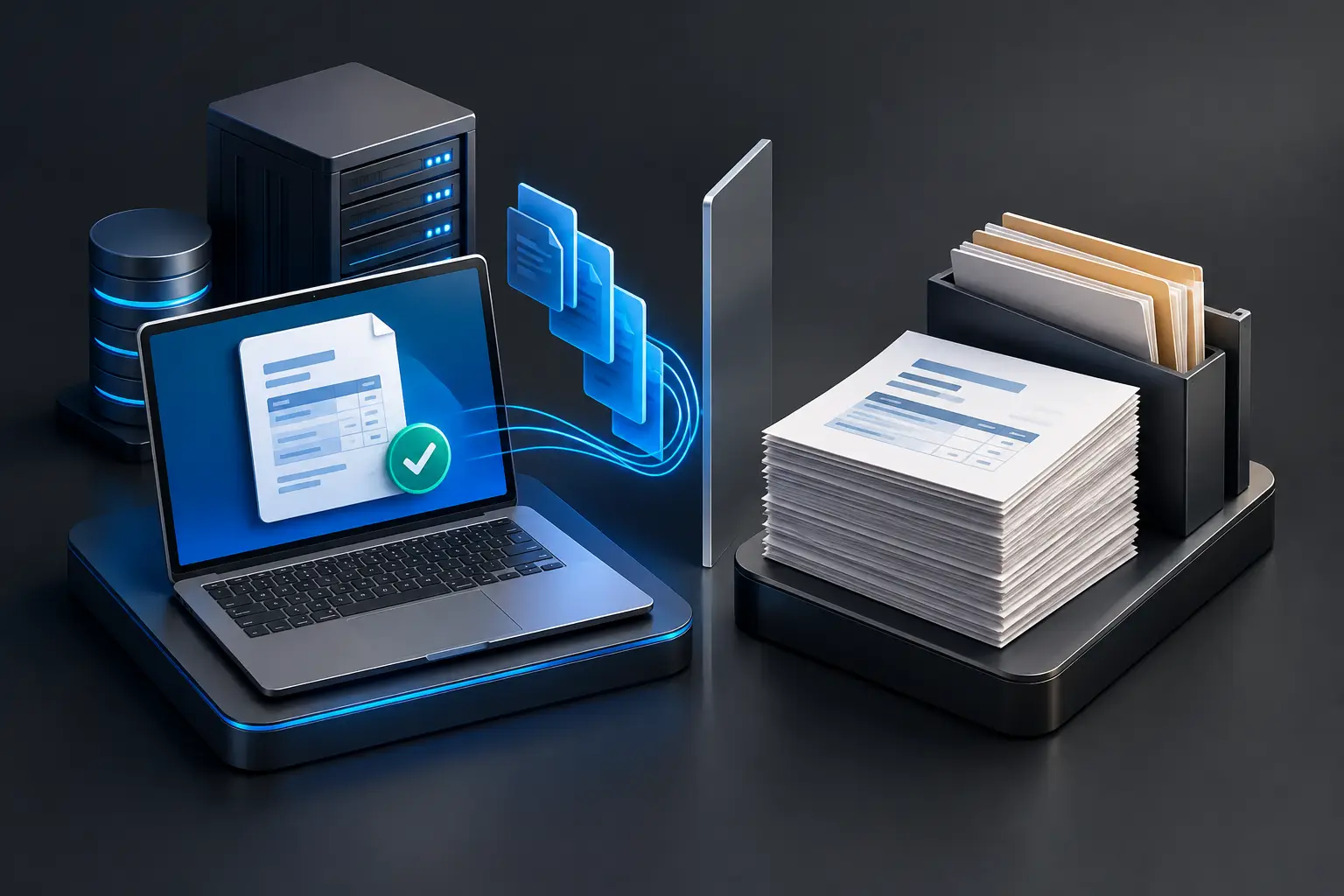
An accounts payable team rejects an invoice because the buyer reference is missing. Finance corrects it in a supplier portal, emails a PDF, and updates JD Edwards later. The invoice may get paid, but the JDE record, the sent document, and the buyer’s accepted version can now differ. This is the operational gap behind JDE eInvoicing versus manual invoicing.
For an existing JD Edwards EnterpriseOne environment, the question is rarely whether invoices can be created. JDE already holds the customer, order, tax, and accounting data. The decision is whether that data reaches each customer in a controlled electronic format, or whether people bridge the last mile through email, print processes, portals, and rekeying.
Manual invoicing can remain appropriate for low volumes or customers with unusual requirements. It also creates hidden dependencies quickly. E-invoicing reduces those dependencies when it is connected to the JDE process that created the invoice.
JDE eInvoicing versus manual invoicing: the real difference
Manual invoicing describes more than printing an invoice from JDE. It often includes downloading PDFs, attaching them to emails, entering invoice data in customer portals, tracking delivery in spreadsheets, and responding to rejections outside the ERP.
E-invoicing sends structured invoice data in a defined electronic format. Examples include XML-based formats such as XRechnung and hybrid formats such as ZUGFeRD. A structured invoice carries data fields that the recipient system can validate and process. A PDF alone is usually designed for people to read.
The practical difference is where the work happens. With manual processes, people interpret, copy, check, and document information after JDE produces the invoice. With e-invoicing, rules and data mapping are established in the integration. Exceptions still occur, but they become visible as exceptions rather than routine work.
That distinction matters because a process can appear manageable until volume, customer requirements, or staffing changes. A single experienced billing specialist may know which portal needs a purchase order number, which buyer expects a specific unit of measure, and which mailbox rejects larger attachments. Those rules are operational knowledge. If they live outside JDE, they are difficult to maintain and audit.
Where manual invoicing creates risk
The cost of manual invoicing is usually not the act of creating a PDF. It is the number of small decisions made around it. Which invoice version was sent? Was the attachment received? Did someone correct the address in a portal? Does the credit note reference the accepted invoice number?
These questions matter during month-end, customer disputes, and audits. They also matter when a local legal requirement changes. The finance team needs evidence of what was generated, transmitted, rejected, corrected, and accepted. Email folders and spreadsheets can provide fragments. They rarely provide a complete trail tied to the original JDE transaction.
We see this pattern in JDE environments with multiple companies and billing teams. In one manufacturing environment, invoices were created correctly in EnterpriseOne. A team then uploaded them to several buyer portals. Each portal had its own mandatory fields and status messages. A rejected invoice could sit outside JDE for days because the billing clerk was waiting for a buyer response. The issue was discovered only when collections asked why payment was overdue.
The problem was not invoice creation. The gap was the missing connection between the JDE invoice, the delivery channel, and the response status.
Manual work also makes change harder. A new customer requirement may require a revised field, format, or routing rule. When the process depends on instructions in a shared document, every user must follow the update consistently. When the rule is part of the e-invoicing configuration, it can be tested and applied in a controlled way.
What JDE e-invoicing changes in daily operations
A useful e-invoicing design starts with the existing JDE invoice process. It should use the data already approved in EnterpriseOne, such as sold-to and ship-to details, tax data, payment terms, order references, and line-level information. The goal is to avoid a parallel invoice process.
For many organizations, the first benefit is data quality. Structured formats expose fields that a PDF process can hide. A missing buyer reference, invalid tax identifier, or incorrect address can be caught before transmission or returned through a defined rejection process.
The second benefit is traceability. Finance and IT can see which invoice was created, which format was generated, what was sent, and whether an error requires action. This supports operational follow-up. It also helps teams answer audit-relevant questions without reconstructing the history from inboxes.
The third benefit is repeatability across companies and countries. The formats and channels vary by jurisdiction and customer. The operating principle should remain consistent: JDE remains the source process, while format-specific rules are configured around it.
A distribution organization illustrates why this matters. Its European company needed XRechnung for public-sector customers, while other customers still accepted PDFs. The team did not need to change how sales orders or invoice batches worked in JDE. It needed reliable routing. Public-sector invoices required a structured output and transmission path. Other customers followed their agreed channel. The critical work was validating the data fields and handling rejections without creating duplicate billing records.
Requirements differ by location and recipient. We treat formats such as XRechnung, ZUGFeRD, and Peppol as technical and operational requirements. Organizations should confirm the applicable legal and tax rules with their qualified advisers.
The trade-offs to assess before automating
E-invoicing requires preparation. Existing JDE data may contain values that were acceptable on a printed invoice but fail structured validation. Customer master data can be incomplete. Address formats, tax identifiers, units of measure, and purchase order references deserve review before broad rollout.
Integration also introduces exception handling that needs ownership. A rejected message must reach the right team. That team needs a defined path to correct the underlying information, regenerate the document where appropriate, and record the outcome. Sending the same invoice repeatedly without understanding the rejection creates further confusion.
For a small number of infrequent invoices, a controlled manual process can be sensible. This is common when a customer has a one-off requirement that does not justify configuration. The process should still define where evidence is retained and how JDE is updated after delivery.
For recurring invoice flows, manual methods become less attractive. The volume threshold varies. Ten invoices with complex buyer rules can consume more effort than hundreds of standardized invoices. The useful measure is the number of touches per invoice, the number of corrections, and the time required to explain a disputed transaction.
Build e-invoicing around the JDE process
We recommend starting with actual invoice paths rather than a general technology discussion. Identify the companies, customer groups, countries, formats, and channels involved. Then examine the exceptions that consume the most time. This reveals whether the main issue is missing JDE data, output formatting, transmission, or status handling.
A pilot should cover more than a successful invoice. Test a missing reference, an invalid address, a rejected transmission, a credit note, and a corrected resend. These are the cases that determine whether the process works at month-end.
The JDE release and tools release also matter. Any extension must fit the environment that is actually running, including existing customizations and batch processes. We work from that point. FlexInvoice, for example, adds XRechnung, ZUGFeRD, and Peppol capabilities inside a running JDE environment. It is introduced alongside existing processes, one controlled step at a time.
A third real-world pattern is a finance team that wanted faster invoicing but first discovered inconsistent order references across customer groups. Automating transmission before correcting that data would have increased rejection rates. The better sequence was to define the reference rule, adjust the JDE process where needed, and test with selected customers. Automation then reduced repeat work instead of moving it elsewhere.
The strongest business case for e-invoicing is often operational clarity. Finance knows where an invoice stands. IT knows which JDE data and rules produce the output. Key users spend less time acting as the bridge between systems. When a customer or regulator changes a requirement, the change has a defined place in the process.
Start with the invoice flow that generates the most rework or uncertainty. A well-tested path gives your team a model for the next company, customer group, or country without forcing a broad change all at once.