
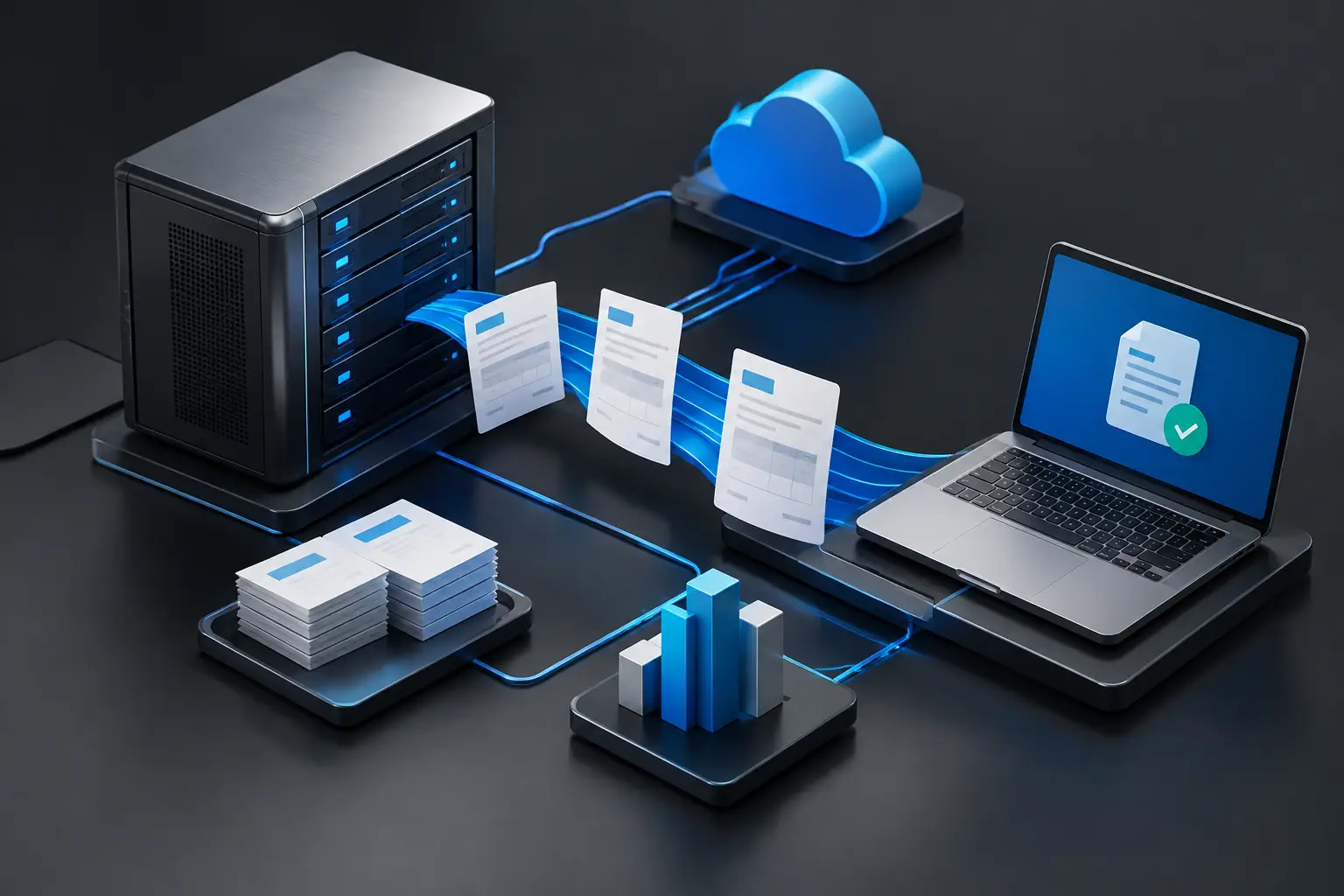
An eInvoice mandate rarely fails because Finance cannot create an invoice. It fails when the required data is incomplete, the outbound document cannot be traced to JDE, or an exception disappears between systems. To prepare JDE for eInvoicing, start with the operating process already in place. The invoice format is only one part of the work.
JD Edwards EnterpriseOne usually holds the commercial facts needed for invoicing: customer master data, sales orders, shipments, taxes, and accounts receivable entries. The challenge is to make those facts consistent, complete, and available at the required point in the process. That requires joint decisions from Finance, IT, and the teams that own customer and order data.
How to Prepare JDE for eInvoicing
eInvoicing means structured invoice data is exchanged or reported in a prescribed electronic format. Depending on the jurisdiction and trading relationship, the document may go directly to a customer, through an approved network, or first to a government platform. Requirements differ by country, document type, and transaction flow.
We therefore begin with scope, rather than selecting a connector. Identify the legal entities, countries, customer groups, and invoice scenarios involved. Separate standard sales invoices from credit memos, debit memos, advance payments, intercompany invoices, and self-billing arrangements. These documents often follow different rules and expose different gaps in JDE data.
Also establish the trigger point. Some processes require an invoice to be submitted before it reaches the customer. Others allow delivery after posting. Your design must define whether the source event is sales update, invoice print, accounts receivable posting, or a controlled batch process. A vague trigger point creates duplicate transmissions and difficult reconciliation later.
Map the invoice lifecycle before mapping fields
A field mapping document is necessary, but it is not the first deliverable. First, map the lifecycle from order entry to payment application. Include the systems and people that touch the transaction: E1 sales order processing, shipping, warehouse systems, tax engines, document management, integration middleware, and accounts receivable.
For each stage, record the system of record and the identifier used. JDE document numbers, order numbers, shipment references, customer purchase order numbers, and external invoice IDs can all be relevant. They must remain connected after an invoice leaves JDE.
In a manufacturing environment we reviewed, invoices were created correctly in E1, but a warehouse application supplied the delivery reference after the invoice batch ran. Several customers required that reference in their structured invoice. The remedy was a controlled release step after shipment confirmation, along with a clear exception queue for missing references. The issue was operational sequencing, not an invoice-format problem.
This lifecycle map should also show reversals. When Finance voids or credits an invoice, the eInvoicing process must transmit the correct follow-up document. Deleting a failed file and sending a replacement may break audit trails and create customer disputes.
Assess JDE data quality where it matters
Structured invoices reject incomplete or invalid data more consistently than PDF-based processes. A customer can often interpret a missing field in a PDF. A validation platform cannot. That makes customer master governance and item-level data central to readiness.
Review the data elements required for each scenario. Typical examples include legal entity name and address, tax registration identifiers, customer endpoint identifiers, payment terms, currency, tax category, unit of measure, item description, and purchase order reference. Requirements can vary between countries and customer networks, so the implementation team needs a maintained requirements register.
In JDE, do not assume one address book record supplies every value. Effective date settings, parent-child structures, address book category codes, tax area assignments, and customer-specific billing instructions can alter the result. A field that looks complete in an inquiry may not be the field used by the invoice batch or integration.
We recommend profiling real transactions from each scope category. Take a representative sample of posted invoices and test whether every required field can be sourced without manual enrichment. Then classify each gap: missing master data, available data in the wrong table, a process issue, or a genuine extension requirement.
Avoid putting permanent business data into free-text fields as a quick fix. It can solve a first transmission, then fail when a customer changes address or when reporting needs consistent values. Where JDE category codes or structured fields fit the purpose, define ownership, validation, and maintenance procedures around them.
Choose an integration design that can be operated
Most organizations use an integration provider, network, or regional service to convert and deliver eInvoices. JDE must provide a dependable outbound payload and receive status information in return. The technical method may use orchestrations, batch exports, application programming interfaces, or middleware. The right option depends on your E1 release, existing integration standards, transaction volume, and internal support model.
An orchestration is a configurable E1 service that can retrieve data, apply logic, and exchange it with another system. It can reduce custom development where the data and process are suitable. It still needs proper error handling, security design, version control, and monitoring. An orchestration that works in a test tool is not automatically ready for daily invoice processing.
Keep the integration boundary clear. JDE should remain the source for commercial and accounting transactions. The external service may validate, convert, route, and report status. Document which system owns each status, who resolves a rejection, and how the resolution reaches the Finance team.
Use idempotency controls as well. Idempotency means the same transmission can be retried without creating a second invoice for the customer or platform. A stable external identifier, transmission log, and status check are practical safeguards. They matter when network timeouts occur after a document has been accepted but before JDE receives the response.
A distribution company had an overnight batch that generated several thousand invoices. A temporary network failure led users to rerun the whole batch. Without a transmission register, the external service received duplicates. We introduced a JDE-based control record keyed by company, document type, document number, and invoice number. The rerun then selected only transactions without a confirmed external submission.
Build controls for exceptions and reconciliation
A successful submission is not the same as a completed business process. The receiving network may accept the file but later reject an invoice for a business-rule error. A customer may receive it but dispute a quantity. Finance needs visibility without searching logs across several tools.
Define a small, usable status model. For example, invoices can be ready, submitted, accepted, rejected, canceled, or pending review. Map external provider codes into this model while retaining the original response for technical analysis. Display the status where the responsible team can act on it, whether in JDE inquiries, a controlled report, or an operational dashboard.
Reconciliation should compare three facts: invoices posted in JDE, invoices sent externally, and invoices with a final accepted or rejected status. The frequency depends on volume and business risk. High-volume organizations may need daily automated checks. Lower-volume operations can use a controlled daily or weekly review, provided overdue exceptions are visible.
Access control also needs attention. The integration account should have only the permissions it requires. Credentials must be managed outside personal user accounts. Retain payloads and response messages according to your records and security policies. For organizations working under European requirements, this is also a useful point to assess data residency, GDPR responsibilities, and NIS2-related operational controls with the appropriate internal specialists.
Test real business cases, not only valid XML
Technical validation confirms that a structured file follows a schema. It does not prove that the invoice is commercially correct. Testing must include the combinations that create work in real operations: multiple tax rates, discounts, freight charges, partial shipments, foreign currencies, credit notes, canceled invoices, and customer-specific references.
Run tests from source transaction through to return status. Verify the displayed invoice, accounting entries, outbound payload, provider response, and reconciliation record. Give Finance users clear evidence that an accepted eInvoice matches the invoice they expect from JDE.
Prepare a production support routine before go-live. It should identify the daily reviewer, escalation path, retry rules, and ownership for master-data corrections. A failed invoice cannot wait for a technical project meeting if it blocks a shipment, payment cycle, or customer relationship.
The strongest eInvoicing projects treat JDE as an operating system with known processes, controls, and accountable owners. Start with a small representative scope, make exceptions visible, and expand once the team can manage the flow without manual detective work.
E-invoicing directly in JD Edwards? FlexInvoice – XRechnung, ZUGFeRD and Peppol in JDE →
Reference: the official Oracle JD Edwards EnterpriseOne documentation describes releases, tools and configuration in detail.